

A question for leaders: where are your people? Not location-wise. But if I pointed to any one family in your school, a valued customer of your organization, any one person on your team, a student, could you tell me where they are – operationally or emotionally – right now?
Are they just getting to know you? Are they in their first month and feeling successful? Or are they in their first month and still figuring out how things work? Settled in and happy? Quietly wondering whether this is still the right place?
Most organizations struggle to know where people are in the journey.
There are the more obvious operational stages of the journey. But even within those obvious operational stages, there are emotional stages. 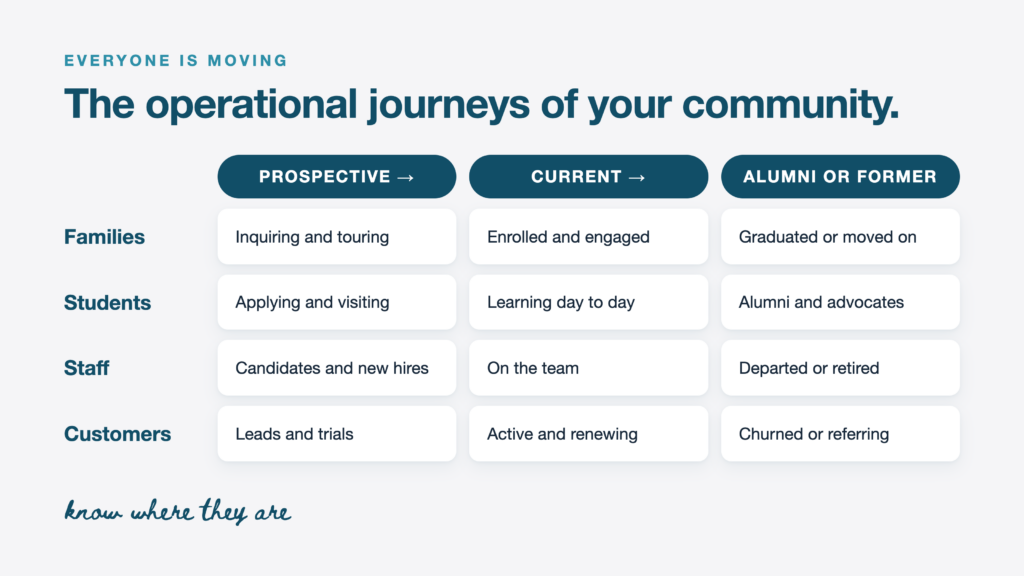
Most organizations know where people are in the operational stages, but don’t know where they are emotionally. Are they a prospect who loves your organization, or are they waffling? Are you their top choice or their tenth choice?
Why don’t organizations explore these questions? Because they are hard. Running the operations is hard enough. Creating capacity for all the humans within it is often beyond what organizations are set up to do. So they keep building around the logistics, the 2-dimensional programs and calendars. They often miss the way people journey, both operationally and emotionally. But here it is.

Everyone Is Moving
Everyone is always on a journey with an organization. A family starts as a name on an inquiry form, becomes a tour, becomes a new enrollee, becomes a part of your community, and eventually becomes alumni or a referral source. A teacher goes from candidate, to new hire, to someone who really knows the building, to someone deciding whether to stay.
The Stages (And the Questions to Ask)
Your stages will have their own names. Here is a simple version that works for families, and with small changes, for staff too.
1. Curious. They’re deciding whether you’re even a possibility.
*Ask: What are you hoping for? What would make this an easy yes?*
2. New. The first weeks and months, when impressions form quickly.
*Ask: What has been easier than you expected? What has been confusing?*
3. Settled. They know the rhythms, and things are mostly working.
*Ask: What’s one thing we do that you’d tell a friend about? What’s one thing you’d change?*
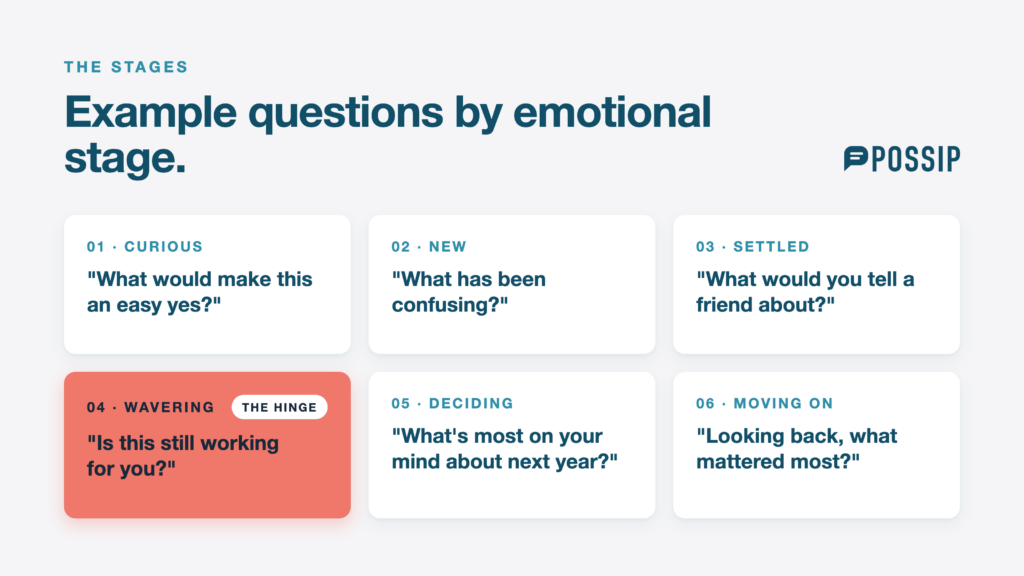
4. Wavering. A realistic stage – probably even for the best of places. The honeymoon is over, the enthusiasm has dipped, and yet people don’t know the systems or community enough to speak up.
*Ask: How is our community working for you? What would you hope to be different?*
5. Deciding. Re-enrollment, re-signing, renewing. Time to be direct.
*Ask: Are you planning to continue with us? What would you like to see continue? Change?*
6. Moving on (or coming back). Graduated, left, or retired from the role, but still part of your story.
*Ask: Looking back, what mattered most? What helped you achieve your goals? What would you tell us?*
Where Do Organizations Lose People?
People leave in the transitions – both operational and emotional. From one school in the feeder to the other. From curious to new, from new to settled, from settled to wavering.
A family who toured and loved you, then heard nothing for six weeks, feels the gap. A new teacher who got a great welcome in August and then was left alone by October feels it too.
So instead of asking only “how satisfied are people?”, try asking “where do we tend to lose people, and what are we hearing right before that happens?”
Try This Month!
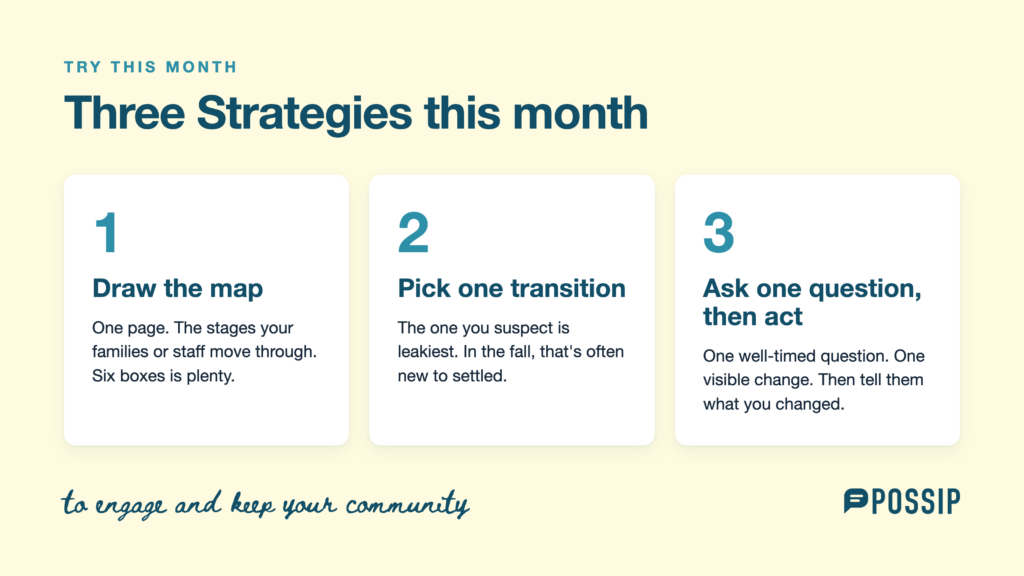 Draw the map.
On one page, write the stages your families (or staff, students, or customers) move through.
Pick one transition.
Choose the one you suspect is leakiest. For many schools in the fall, that’s the move from new to settled. Or from elementary school to middle school. Or from a first year as a customer to a second year. This is the stretch where the early excitement meets real life.
Ask one question, then do something about it.
Ask one well-timed question to people in that stage, look at what they say, and make one visible change. Then tell them what you changed. People who see their feedback matter tend to stay in the conversation.
If this sounds familiar, it’s the Win Cycle (Goal, Understand, Systems, Engage, Act) applied to each stage instead of to the whole community at once.
Moving Ahead
You don’t need a bigger survey. You need to know who you’re listening to, and when.
The people in your system are always somewhere in a cycle. The leaders who do well can say where and who they’ve set up to hear from people at the moments that matter most, before the quiet turns into a goodbye.
Want help building listening into every stage of your community’s journey? See how Possip helps leaders listen, learn, act, and win: [possip.com](https://possip.com)