

Students and staff need to feel comfortable in their learning environment. Here’s a round up of valuable snippets that Marianna Merritt shared in the session we hosted this winter: A Welcoming School Climate: Creating Spaces for Safety, Inclusion, and Belonging.
Jump To...
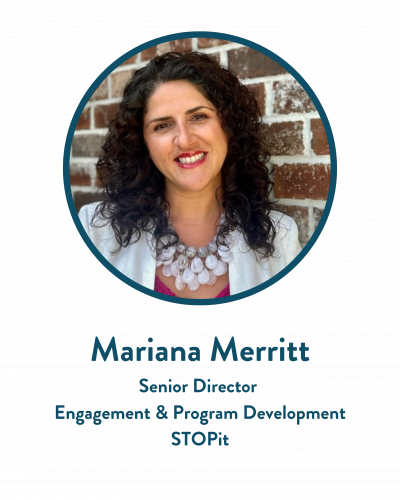
Meet Mariana
Mariana Merritt, MSW joined us from STOPit, where she serves as the Senior Director of Engagement and Program Development. STOPit provides solutions to help protect students, employees, and communities from social isolation, bullying, acts of violence, and basic needs challenges. Prior to her work with STOPit, Mariana worked with Communities in Schools of Tennessee as a Coordinator of Family Engagement, Coach, and Site Coordinator.
Students Ask For Love And Belonging
Transcript:
Mariana Merritt: During the pandemic, [STOPit] realized that 85% of the tips that were coming through were actually students saying I need help. I’m not okay. And so reaching out for support, they created a sister platform called Help Me and so help me focus this on creating one to one connection. So students, families, staff can access support at any time that they’re having deep struggle. They can access resources if they’re felt needs, self help tools, information so that our teams aren’t just getting their information on somebody on TikTok with great lighting. But making sure that we’re empowering them with really valuable information about development, about what’s happening for them.
And then the second button is access to a crisis counselor, 24 7 through crisis text line. We know that when people are in trouble, they have a hard time with the Google machine and making sure that they’re going to the right place. Okay.
transcri
And then finally that ask for help connects them to their school directly in an anonymous chat. They can self identify or they can leave it anonymous. They can also indicate how they would like to receive help back. So, my work with STOPit is really coming alongside of the company and our schools and thinking about How do we integrate? How do we engage our users and hear from them? What do they need? And then how do we create systems that make sense for schools? We know that schools are overwhelmed. And really wanting to make sure that our supports come alongside in a really helpful, kind of seamless way that allows them to align their supports.
So I am loving all of the data that you’re exposing us to this morning. I have to say I wondered I just had a random wondering about middle school and why bullying would be your highest in middle school. And I just thought about how deeply middle schoolers feel rejection and acceptance of peers and how interpretation at the middle school level would absolutely drive their experience of what’s happening. And filter that lens of this is bullying, this feels like bullying to me because it is so deep. We know the kids have huge needs right now. I’m gonna give Erica some top space but I definitely have some other thoughts on the data, too.
Family Engagement That Centers Love and Belonging
Transcript:
Mariana: I think so often when a child is struggling, the messaging towards the family is like get this under control why is this happening there’s a lot of shame and blame and It may be stems from hurt and fear on the schools part. Like this person is causing harm in our school. Community. I think shifting our paradigm to embracing all valuable people in our school community and saying like you are loved and you belong here. And you are struggling and because you’re struggling we’re gonna rally and we’re gonna rally by bringing your family in and we’re gonna have conversations that don’t pick mom and dad against you.
I think It is so painful when you are sitting in meetings at schools that are discipline meetings. And somehow that all the adults are on one side of the table and the kids on the other and it feels really lonely there for the kid, right?
And so, I think that family engagement has to be about authentic partnership hinged on the fact that we have a shared goal. As educators and as family members, we deeply love and are committed to this child success and well being holistically. And so if discipline conversations start with that tone, if we express directly too: that, hey, we’re having a moment of struggle. Or things happened that aren’t okay, but because we love your child so much, we wanted to call you in and we want to partner with you to figure out what other supports do they need. That conversation goes wildly different.
Trauma-Informed Training
Transcript:
Mariana: I definitely love, love, love, the movement of trauma informed, training that has some steady momentum- I think schools and districts that are implementing trauma-informed training even with children who are not traumatized or trauma reactive. Again, it is that skill building. It is building the awareness that when I am activated, I am just regulated when I’m just regulated. I cannot access the learning part of my brain. When I notice and increase my awareness, I have tools and strategies. Talked to me to help me come back into my body. That is a benefit for all of America. Like let’s go ahead and get everybody trained.
Removing Shame & Blame
Transcript:
Mariana: Yes, and development is messy. They’re gonna mess up; they’re gonna fall; they’re gonna take risks that are gonna blow our minds until we remember that we took the same rest too. But I think removing that shame and, and blame and really allowing for. Information for all stakeholders. So children, families. Our educators for sure.