

No matter where you are, back-to-school season offers you another new year. It’s a natural reset; a chance to plan, to look forward, and to ask what you actually want the next twelve months to look like.

One tool we love for that kind of reset is a platform called Best Year Yet. It’s simple: you write out the story you want for the year. What’s your vision? What do you want to achieve? Who are the people helping you get there? Whether you use a tool like Best Year Yet or just simply a piece of notebook paper, the idea is the same. Craft your vision for the year. Why?
Years ago, early in Possip’s work, I was leading a training with a group of school leaders. Part of what I wanted them to do before the year started was define their vision: what they wanted their school year to feel like, what they wanted people to say about the front office, about what students were learning, about the culture they were building.

Part of why this vision mattered so much was because the listening systems like Pulse Checks were designed to help the leaders know to what extent they were, or were not, meeting their goals and vision.
A few minutes into the training, I realized most of them were struggling. They didn’t have a vision or goals for the year. They hadn’t really been asked to and hadn’t had the space and time to think about it – big picture or in more detail. Btw, if you want a partner to help you go through a planning process like this – whether with a tool like BYY or otherwise- reach out! We’d love help.
The gap between a vision and strategy and a daily plan shows up everywhere, and it shows up especially in how organizations approach listening.
The Problem with Listening Systems Built Backwards (In the Wrong Way)
Well, most organizations don’t have a listening system. Those that have any semblance of a listening system build it the way those leaders almost walked into their year: without a vision to build from. A survey goes out because it’s the season for one. A feedback loop gets stood up because leadership asked for “more data.” The questions get written first, and the strategy (if there is one)gets reverse-engineered from whatever answers come back. It reminds me of the first test I gave my students as a first-year teacher. The test and the content plans were not connected :). When I learned of backward planning a few weeks later, it made so much sense and made the randomness I had put in front of my students just weeks earlier laughable.
But it’s what most surveys are. Listening without a theory of change or a framework. And it’s why so much feedback data ends up sitting in a dashboard that is hard to act on.
Design Backwards. Implement Forward.
The fix isn’t complicated, but it does require discipline. We call it Start Forward, Design Backwards: define the outcome you want first, then build the listening system that makes it possible.
“Start forward” means beginning with a real vision; the same exercise as writing the story of your year. What change are you actually trying to create? “Design backwards” means build a system understanding what people need to do (both the leaders and the people in your community) and therefore what you need to learn and understand. Then, every decision after that, every question you ask, every piece of data you collect, gets built by working backward from that vision, not forward from whatever’s easiest to measure.
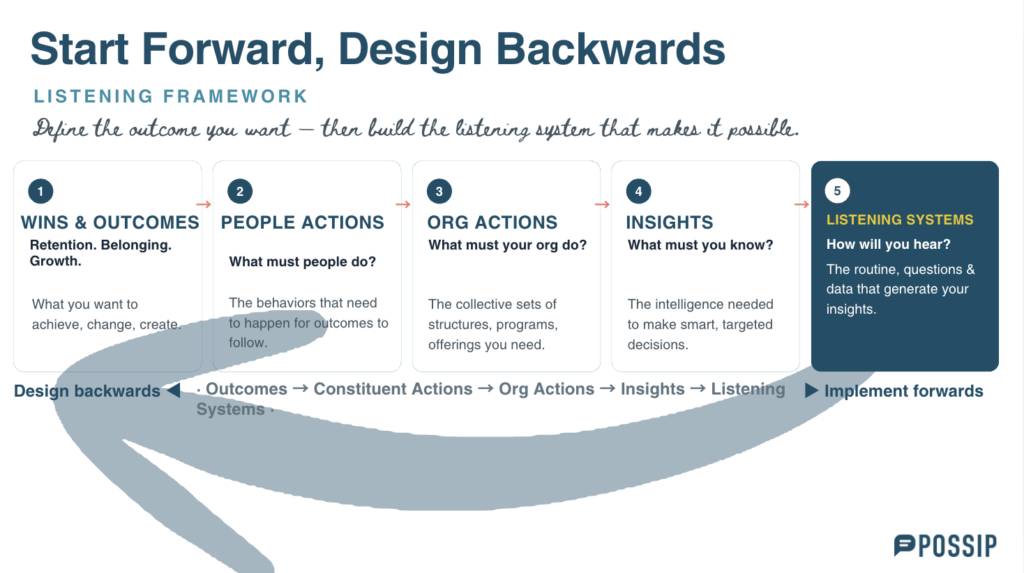
In practice, that means answering five questions, in this order:
1. Wins & Outcomes: What are you trying to achieve? This is the change your organization wants to create: retention, belonging, growth, achievement, revenue or funding, whatever it is for you. Paint it as a metric but also as a narrative: a real and specific picture of the future you’re building toward.
2. People Actions: What’s your theory on what has to happen to get there? If that’s the outcome, what do the people closest to the work- employees, students, families, teachers, nurses, customers- need to actually do differently for that outcome to follow? This helps turn a vision turns into a theory of change.
3. Org Actions: What does your organization need to do to make the outcomes and wins possible? The programs, advising, outreach, and support that enable people to take the actions in step two. This is your organization’s half of the theory: the conditions you’re responsible for creating.
4. Insights: What do you need to know? Now, and only now, you can ask what intelligence you actually need to make smart, targeted decisions about steps two and three. Not “what would be interesting to know,” but “what do we need to know to know if this is working.”
5. Listening Systems: How will you hear it? Last comes the mechanism: the routine, the questions, the data collection that actually generates the insights from step four. This is where the survey, the check-in, the feedback loop finally gets built. Notice how far down the list it is.
Implement Forwards
Once you’ve designed backwards from your outcome, you implement in the opposite direction. Your listening system generates insights. Those insights inform your org actions. Your org actions enable people to act. And those actions, over time, produce the outcome you started with.
Design backwards. Implement forwards. Same five steps, run in reverse order for two very different jobs—one to plan, one to execute.
Where to Start
You don’t need a strategic planning offsite to do this. You can use a partner like Possip, a platform like Best Year Yet, or about ten minutes and a blank page. Or all of the above.
So this year, as you’re thinking about what you want to learn from your community, write a story for the year.
What’s your vision for the next twelve months? What do you want to be true that isn’t true yet? Who has to do what for that to happen?
When you answer those questions, the listening system you build will tell you so much worth knowing.
Want help building a listening system anchored in real strategy—not just another survey? See how Possip helps leaders turn a vision into a theory of change, and a theory of change into action: Contact Possip