

Right now it’s alumni engagement season. It’s also new family recruitment season. We’re in the thick of nonprofit fundraising season. And it’s always staff recruitment and retention season.
Multiple audiences, goals, different calendars, budgets, and people in charge. Most organizations treat them as separate jobs.
But they share the same question underneath: how do you line up your goals, your systems, and your actions so you actually know your community, engage your community, and move toward the outcome you want?
It’s a Win Cycle. And it’s a loop, not a checklist
The Win Cycle Community Engagement Framework
Most plans are straight lines. You set a goal, you do some things, you check in at the end of the year. The Win Cycle has five steps, and the last one feeds back into the first.
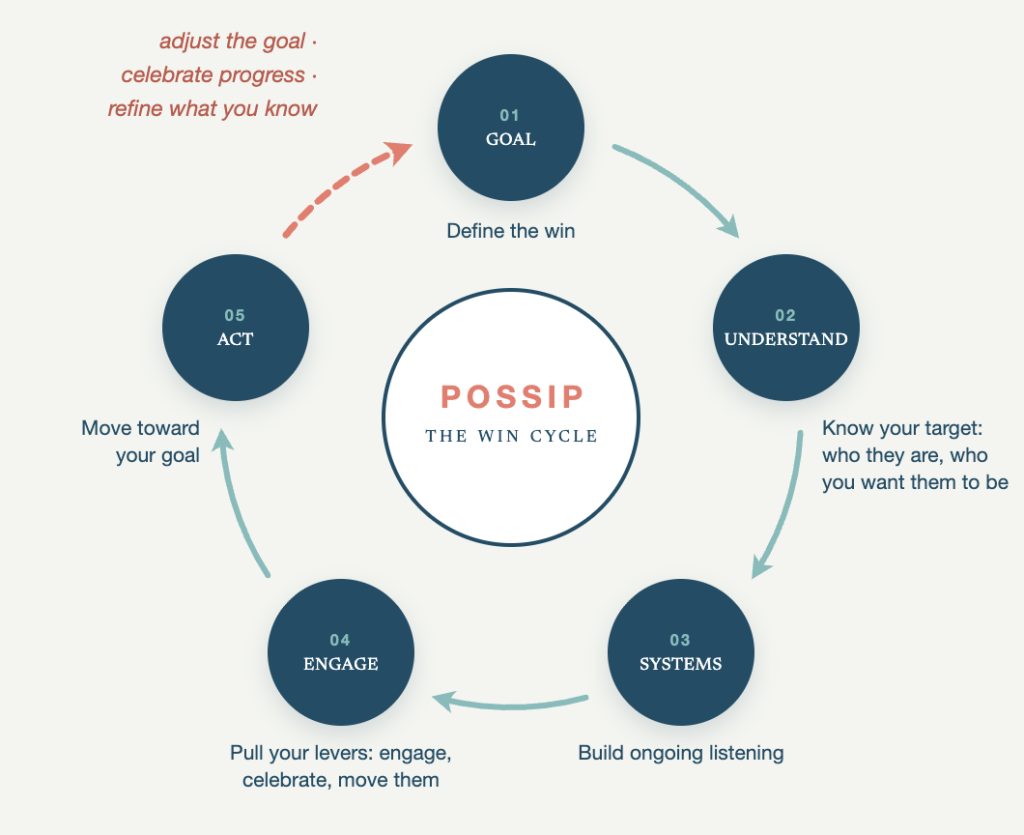
1. Goal: Define the win.
Get specific about what winning looks like for this group. Not “better engagement.” A real outcome you could recognize: alumni who show up and give back, families who enroll and stay, teachers who come back in August, an increase in your end-of-year giving campaign. Define a win that drives your dollars or your impact – and even better, BOTH!
2. Understand: Know your target.
Who are the people you seek to engage today, and who do you want them to be? What actions do you need them to take? What do you need them to know? Believe?
3. Systems: Build ongoing, dynamic, holistic listening.
This is the infrastructure that lets you learn from your people continuously. This also gives you the flexibility to ask different questions throughout the year, aligned to your organizational needs and your community’s experiences. This allows you to build a RESPONSIVE listening journey and system. If you only hear from people when you remember to ask, you aren’t listening yet. You’re sampling. And when you only ask based on closed-ended questions, you’re not listening; you’re giving them a multiple-choice test or questionnaire.
4. Engage: Pull your levers.
With the information you get from listening, you now have levers you can pull. What can you actually do to engage, celebrate, and move this group? Every relationship has a handful of levers available. Name them, so you’re choosing deliberately instead of defaulting to whatever you did last year.
What are examples of levers? Events you can put on, trainings you can do, communications you can send, strategies or decisions you can adjust.
5. Act: Move toward the goal.
Act and move (and win!). This is where your levers become forward motion in the direction you set in step one.
Then you come back to the start. Somewhere between acting and redefining the win, you adjust.
Maybe you celebrate progress.
Maybe you realize your community looks different than you thought.
Maybe the goal itself shifts.
The gap between step five and step one is where leadership happens,.
Same Framework, Three Very Different Jobs
Run the Win Cycle against alumni, new families, donors, students, staff, and the framework doesn’t change. Only the answers do.
Want help building the listening system behind your Win Cycle? See how Possip helps leaders listen, learn, act, and win: https://possip.com/contact-possip/
Keep Reading Other Possip Resources:
https://possip.com/listening-strategy-framework/